
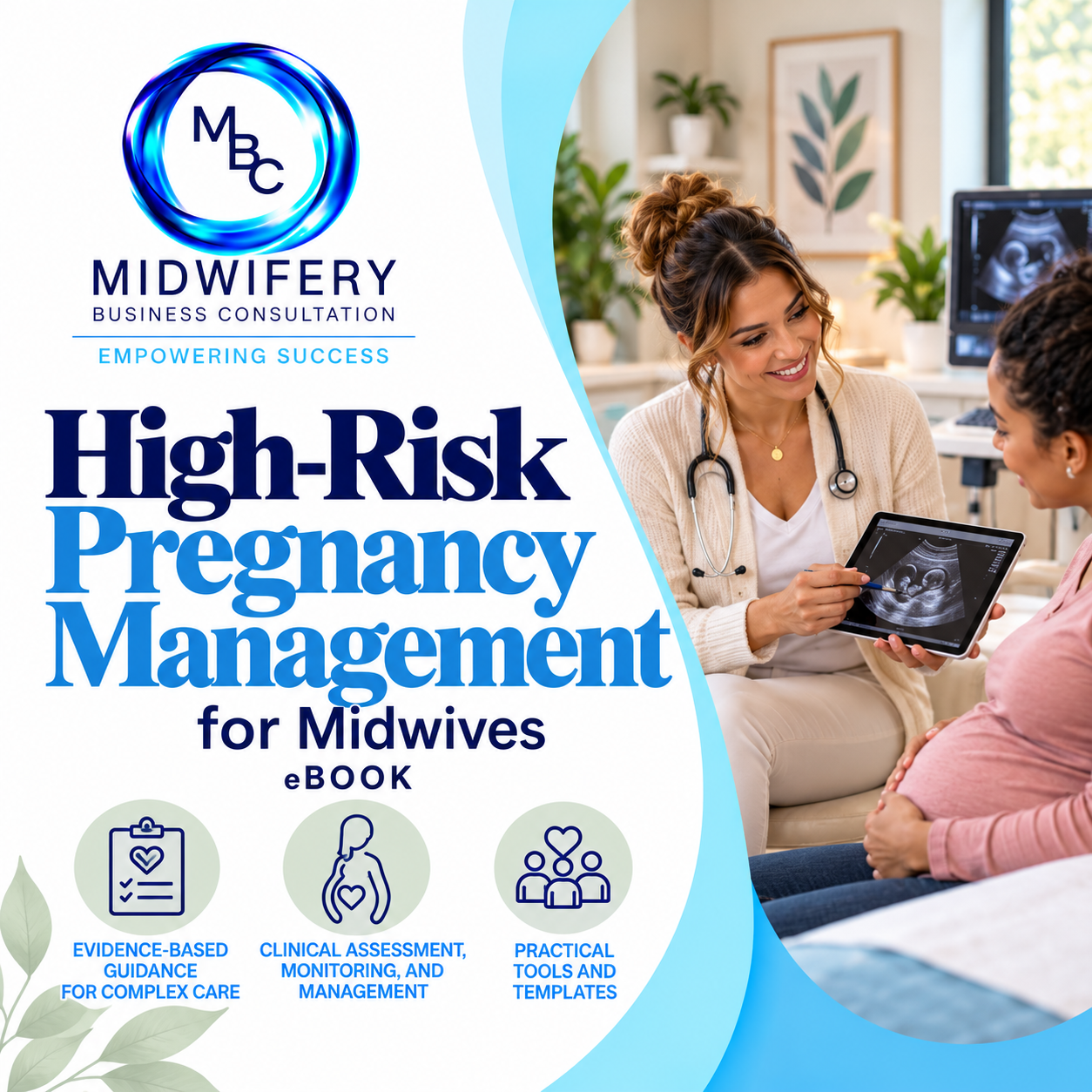
High-Risk Pregnancy Management for Midwives eBook
Midwifery care includes knowing how to support normal physiologic pregnancy—and recognizing when pregnancy is no longer following a low-risk course.
Pregnancy risk is not always obvious at the first prenatal visit.
Maternal conditions can develop. Laboratory results can change. Fetal concerns can emerge. A patient who initially appears appropriate for routine midwifery care may require additional surveillance, consultation, co-management, referral, transfer, or a different planned birth setting as pregnancy progresses.
The High-Risk Pregnancy Management for Midwives eBook provides midwives with a comprehensive educational resource for approaching risk identification, assessment, clinical decision-making, consultation, referral, collaborative care, surveillance, and escalation throughout pregnancy.
The goal is not to teach midwives to independently manage conditions outside their scope.
It is to strengthen the midwife’s ability to recognize risk, understand its implications, participate appropriately in care, communicate effectively with the healthcare team, and identify when the plan of care needs to change.
Move Beyond “Low Risk” Versus “High Risk”
Pregnancy risk exists on a continuum.
Some findings require monitoring.
Others require additional testing.
Some require specialist consultation or collaborative management.
Others may make a particular birth setting inappropriate or require transfer of primary management.
This eBook encourages a more thoughtful question:
What does this finding mean for this patient, and what needs to happen next?
Strengthen Risk Assessment
Effective management begins with recognizing risk.
Explore considerations related to:
- Comprehensive health history
- Obstetric history
- Previous pregnancy complications
- Medical conditions
- Surgical history
- Medications
- Family history
- Social determinants of health
- Mental health considerations
- Substance use
- Nutrition
- Maternal age
- BMI and metabolic risk
- Laboratory findings
- Ultrasound findings
- Fetal growth
- Placental concerns
- Multiple gestation
- Changes developing throughout pregnancy
Risk assessment should be an ongoing process—not a one-time determination at the beginning of care.
Maternal Conditions
The eBook can help midwives strengthen their understanding of pregnancy complicated by conditions such as:
- Chronic hypertension
- Gestational hypertension
- Preeclampsia
- Diabetes
- Thyroid disorders
- Obesity
- Anemia
- Hematologic conditions
- Renal disease
- Cardiac disease
- Autoimmune conditions
- Seizure disorders
- Infectious disease
- Mental health conditions
- Substance-use concerns
- Other significant maternal medical conditions
The focus is on understanding how these conditions may influence pregnancy, what findings require increased attention, and when additional expertise or higher-acuity management is indicated.
Pregnancy-Specific Complications
Explore clinical considerations surrounding complications such as:
- Hypertensive disorders of pregnancy
- Gestational diabetes
- Hyperemesis
- Antepartum bleeding
- Placental abnormalities
- Preterm labor
- Preterm premature rupture of membranes
- Fetal growth abnormalities
- Amniotic fluid abnormalities
- Multiple gestation
- Malpresentation
- Rh alloimmunization and other sensitization concerns
- Cervical concerns
- Post-term pregnancy
- Other conditions that may alter pregnancy management
Recognize Fetal Risk
High-risk pregnancy management includes evaluating fetal well-being and recognizing when additional assessment may be needed.
Topics may include:
- Fetal growth
- Size-date discrepancies
- Suspected fetal growth restriction
- Suspected macrosomia
- Fetal movement concerns
- Amniotic fluid abnormalities
- Placental concerns
- Abnormal ultrasound findings
- Fetal anomalies
- Multiple gestation
- Malpresentation
- Antenatal surveillance
- Referral for specialized evaluation
Understand Maternal & Fetal Surveillance
Depending on the clinical condition and the midwife’s role, patients with increased risk may require additional surveillance.
The eBook can introduce considerations surrounding:
- Blood pressure monitoring
- Laboratory surveillance
- Glucose monitoring
- Maternal symptom assessment
- Fetal movement assessment
- Ultrasound
- Fetal growth surveillance
- Amniotic fluid assessment
- Nonstress testing
- Biophysical assessment
- Other condition-specific monitoring
Midwives should understand not only what testing may be recommended, but why it is being performed and how results may affect the plan of care.
Know When to Consult, Refer, Co-Manage, or Transfer
One of the most important skills in midwifery is recognizing when additional expertise is needed.
The eBook explores the distinctions among:
Consultation — obtaining additional clinical expertise while continuing an appropriate role in care.
Referral — directing the patient to another qualified professional for evaluation or management.
Co-management — sharing aspects of care among clinicians according to qualifications, scope, and the patient’s needs.
Transfer of care — transitioning primary management when the patient’s condition requires care beyond the midwife’s scope, resources, or practice setting.
These decisions should be based on the clinical situation, professional scope, applicable regulations, practice setting, available resources, and individual patient needs.
High-Risk Pregnancy & Community Birth
For home birth and birth center midwives, increasing pregnancy risk may also raise another important question:
Is the planned birth setting still appropriate?
This resource can help clinicians think through:
- Initial eligibility
- Ongoing eligibility
- Changing risk factors
- Consultation
- Additional surveillance
- Hospital-based evaluation
- Specialist referral
- Collaborative care
- Planned change in birth setting
- Nonemergent transfer of care
- Communication with patients when plans need to change
The goal is not simply to identify risk but to recognize when that risk changes the safest or most appropriate available care pathway.
Communicate Risk Clearly
Complex pregnancies require thoughtful communication.
Patients need understandable information about:
- The clinical finding
- What is known
- What remains uncertain
- Potential implications
- Recommended evaluation
- Available options
- Benefits and risks
- Consultation recommendations
- Referral recommendations
- Changes in monitoring
- Changes in planned birth setting when applicable
- Warning signs requiring urgent evaluation
Shared decision-making requires meaningful information—not simply obtaining a signature.
Documentation Matters
Higher-risk situations often require particularly clear documentation.
Consider documenting:
- Clinical findings
- Risk assessment
- Patient symptoms
- Test results
- Clinical reasoning
- Recommendations
- Consultation
- Communication with other clinicians
- Referral
- Patient counseling
- Informed decision-making
- Follow-up plans
- Escalation instructions
- Changes in planned care or birth setting
Designed for Midwives Across Practice Settings
This eBook may be valuable for:
- Certified Nurse-Midwives
- Certified Midwives
- Certified Professional Midwives
- Licensed Midwives
- Student midwives
- Home birth midwives
- Birth center midwives
- Hospital-based midwives
- Women’s health clinicians
- Midwives returning to clinical practice
- Clinicians strengthening prenatal risk-assessment knowledge
Individual scope and authority vary by credential, jurisdiction, employer, and practice setting.
Strengthen the Skill of Knowing When Care Needs to Change
Excellent midwifery care is not defined by keeping every pregnancy within midwifery management.
It includes recognizing when a patient needs additional surveillance, consultation, collaboration, specialist care, hospital resources, or transfer of management.
The High-Risk Pregnancy Management for Midwives eBook is designed to strengthen that clinical awareness.
Recognize risk. Understand the implications. Collaborate appropriately. Escalate when needed. Support safer maternity care.
Digital Product Notice
This is a digital educational eBook intended for the individual purchaser’s personal professional education. The content may not be copied, reproduced, publicly posted, distributed, resold, uploaded to shared drives or educational platforms, or shared with other individuals or organizations without prior written permission from the copyright holder.
Important Clinical Disclaimer
This eBook is provided for general professional education only. It does not constitute individualized medical advice, clinical consultation, diagnosis, treatment recommendations, legal advice, or a universal clinical protocol or standard of care.
The term “management” in this resource does not imply that every midwife is qualified, authorized, or appropriately resourced to independently manage every high-risk condition discussed.
Midwifery scope of practice, consultation requirements, referral requirements, prescribing authority, hospital privileges, community-birth eligibility criteria, and authority to manage pregnancy complications vary substantially by credential, jurisdiction, practice setting, employer, patient condition, and clinician training and experience.
Clinical care should be based on current evidence and guidelines, applicable professional standards and regulations, individual patient circumstances, available resources, clinician qualifications, and appropriate consultation or referral.
Information in clinical resources can become outdated as evidence and professional guidance change. Clinicians are responsible for verifying current recommendations with appropriate authoritative clinical resources before applying information to patient care.
This eBook should supplement—not replace—professional education, clinical judgment, consultation, collaboration, referral, institutional protocols, or specialist care when indicated.
Reviews
There are no reviews yet.